Why Are High-Speed Optical Modules Increasingly Dependent on High-Performance Optical Isolators In the AI Era?
2026-05-13
In the wave of rapid artificial intelligence (AI) development, large language model training, inference, and massive data processing have placed unprecedented demands on computing power. Data centers are evolving from traditional architectures to AI clusters, where GPU interconnects require extremely high bandwidth, low latency, and high reliability. This is directly driving high-speed optical modules toward 800G, 1.6T, and even higher data rates. However, during optical signal transmission, even the slightest reflection or feedback can cause catastrophic consequences. High-performance optical isolators have therefore become indispensable core passive components in high-speed optical modules. Acting like “one-way valves,” they ensure that optical signals can only travel in a single direction, effectively blocking reverse light and protecting lasers and the entire system for stable operation.
Challenges Faced by High-Speed Optical Modules in the AI Era
The characteristics of AI workloads involve massive parallel computing and continuous high-intensity data exchange. Training a large model may involve tens of thousands or even hundreds of thousands of GPUs working collaboratively, with data flowing at high speeds within the cluster. This requires optical modules to support higher transmission rates, lower bit error rates (BER), and stronger environmental adaptability.
In traditional data centers, the impact of reflected light in lower-speed optical modules could still be tolerated. But in high-speed scenarios:
· Extremely High Laser Stability Requirements: High-speed direct modulation or coherent modulation is highly sensitive to laser wavelength stability and output power consistency. Any back-reflections from connectors, fusion splices, or fiber end faces can cause laser mode hopping, increased intensity noise, or even device damage.
· Increased Signal Integrity Pressure: Higher data rates mean smaller signal margins; noise caused by reflections significantly raises the system’s bit error rate, affecting the reliability and efficiency of AI computations.
· Thermal Management and Dense Deployment: Optical modules in AI clusters are highly densely packed, with greater temperature fluctuations and mechanical stress, making reflection issues easier to amplify.
· Zero Tolerance for Low Latency: AI inference has stringent real-time requirements; any retransmission or error correction incurs latency penalties.
These challenges mean that relying solely on laser chip optimization or system design is no longer sufficient. High-performance optical isolators must be introduced to “purify” the optical path.
Core Functions and Working Principle of Optical Isolators
Optical isolators are based on the Faraday Effect. They utilize the non-reciprocal rotation of the polarization plane of magneto-optical materials in a magnetic field to achieve unidirectional transmission. Forward light passes with very low insertion loss (typically <0.5 dB), while reverse light is strongly attenuated (isolation typically reaching 30 dB or higher).
In high-speed optical modules, optical isolators are usually integrated into the TOSA (Transmitter Optical Sub-Assembly), positioned close to the laser output. They can:
· Prevent laser self-oscillation and noise accumulation.
· Reduce crosstalk in multi-channel DWDM/CWDM systems.
· Protect amplifiers such as EDFAs from reflection effects.
· Improve overall link performance, especially in long-reach or high-power applications.
With the rise of silicon photonics (SiPh) integration and co-packaged optics (CPO) trends in the AI era, optical isolators also need to evolve toward miniaturization, high integration, and high-power handling capability.
GLSUN High-Performance Optical Isolator Product Series: Reliable Support for AI Optical Modules
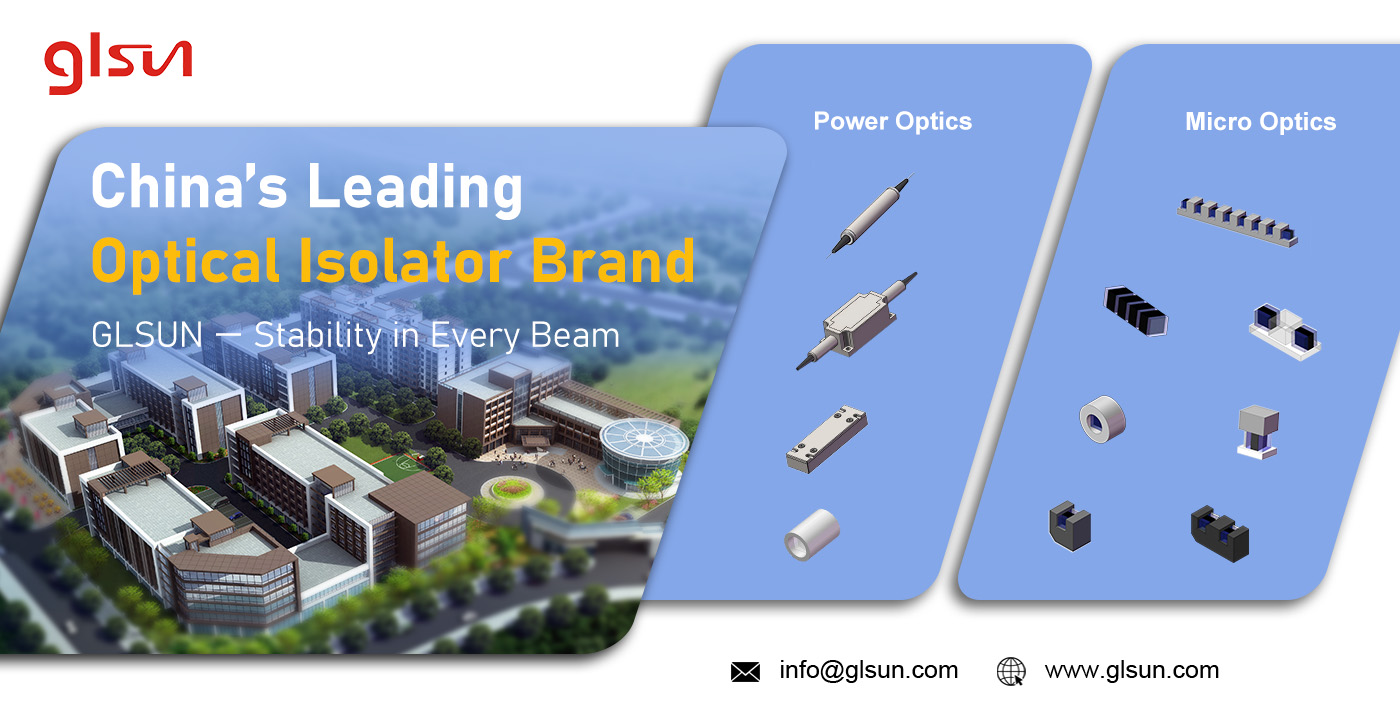
As a professional manufacturer in the optical communications field, Guilin GLSUN Science and Technology Group has been deeply engaged in Faraday optical devices for many years. It has launched a series of optical isolators tailored to the needs of AI high-speed optical modules. These products feature high isolation, low insertion loss, compact size, and wide-temperature operation, making them widely suitable for laser coupling, laser diode packaging, high-speed transceiver modules, and data center interconnects.
1. Free Space Optical Isolators
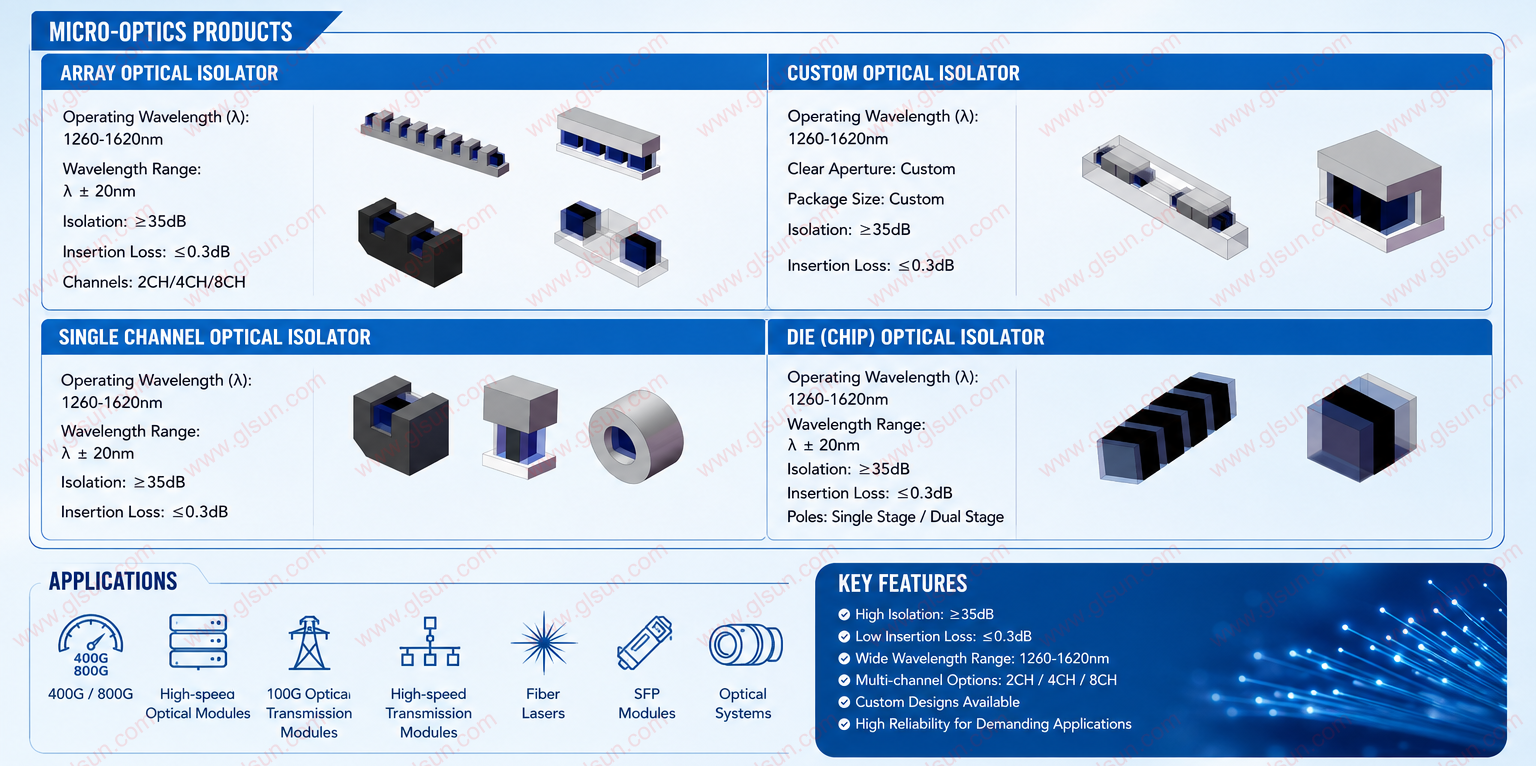
GLSUN’s free space isolators are compact with high isolation, making them especially suitable for integration inside TOSA/optical modules. They adopt precision optical designs and support mainstream wavelengths such as 1310/1550 nm. High isolation effectively blocks back-reflections, ensuring stable laser operation. In the dense optical interconnects of AI clusters, these devices can significantly reduce noise and enhance system reliability.
2. Isolators with Receptacle
This product integrates the isolator with standard LC/SC receptacles, providing convenient connection interfaces. Center wavelengths are 1310/1550 nm or custom; isolation >30 dB (typical), insertion loss <0.3 dB, operating temperature -40~+85°C, and RoHS 6/6 compliant.
Designed specifically for laser coupling and laser diode packaging, it facilitates automated assembly in high-speed optical module production and is an ideal choice for mass production of AI data center optical modules. Its compact size and reliable performance help module manufacturers address high-density deployment challenges.
3. In-Line Optical Isolators
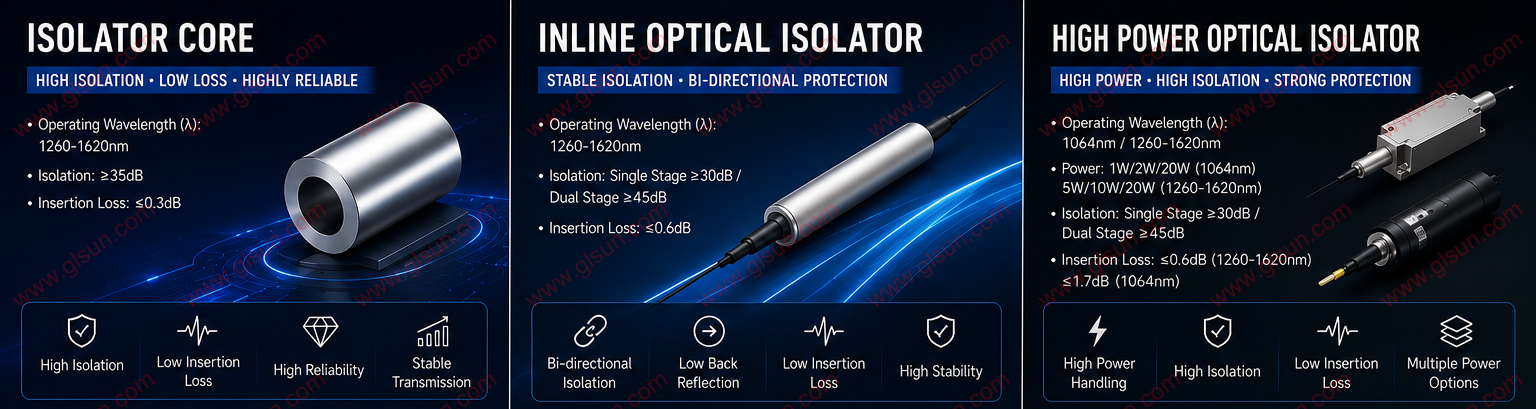
Available in single- or dual-stage configurations for fiber optic lines, supporting 1310/1550/1590 nm wavelengths. Typical single-stage isolation >40 dB (higher for dual-stage); insertion loss as low as 0.4 dB (typical), low PDL/PMD, epoxy-free optical path, and Telcordia standard compliance.
In EDFA, DWDM/CWDM systems, and high-speed optical module testing and applications, it effectively suppresses reverse transmitted signals and protects the entire link. The AI era’s demand for long-reach, low-loss interconnects makes this product a key enabler.
4. Pigtail Free Space Optical Isolators
Combining pigtail connection technology for easy integration with existing fiber systems, these also offer high isolation and low loss, suitable for scenarios requiring flexible cabling.
5. High-Power Optical Isolators
Capable of handling 1W to 10W or even higher power (specific models such as 1064 nm 2W/20W), these achieve high isolation based on the Faraday effect. They are suitable for high-power laser applications and AI infrastructure expansion scenarios that need to handle strong signals, ensuring stability under high loads.
All GLSUN product series emphasize RoHS compliance, wide temperature range, and customization capabilities to meet the personalized needs of different AI optical module suppliers. From chip-level integration to module-level applications, GLSUN devices help customers build more reliable high-speed optical interconnect systems.
Future Outlook: Deep Integration of Optical Isolators and AI Optical Modules
As AI evolves to higher levels, optical modules will advance toward 1.6T+ and CPO/SiPh co-packaging. Optical isolators must also upgrade synchronously: smaller footprints, higher isolation (>50 dB), wider operating wavelength bands, and compatibility with silicon photonics platforms. Companies like GLSUN are driving this integration through continuous technological innovation.
In addition, high-performance isolators will play an even greater role in emerging fields such as quantum communications, optical sensing, and edge AI. They are not only “protectors” but also key enablers for improving the energy efficiency and reliability of entire optical networks.
In the AI era, the performance bottlenecks of high-speed optical modules are no longer limited to chip speed alone, but also to the control of every detail in the optical path. High-performance optical isolators build a solid defense for lasers and systems by eliminating reflection interference, directly determining the computational efficiency and stability of AI clusters. With its comprehensive optical isolator product series — ranging from free space, receptacle, in-line, to high-power models — GLSUN provides mature and reliable solutions for global optical module manufacturers. Choosing high-performance optical isolators means selecting a more robust future for AI infrastructure. Facing explosive growth in computing power, only when every optical path is “unidirectional, smooth, and worry-free” can the full potential of AI be truly unleashed. GLSUN will continue to work hand-in-hand with industry partners to build an efficient and intelligent optical communications ecosystem.