TGG vs. TSAG: Technical Differences and Applications of Two Leading Magneto-Optical Crystals
2026-11-25
As laser technology continues to advance toward higher power, greater stability, and improved efficiency, magneto-optical crystals are playing an increasingly important role as core materials in Faraday rotators and optical isolators. Among these materials, TGG (Terbium Gallium Garnet) and TSAG (Terbium Scandium Aluminum Garnet) have attracted considerable attention. Both offer strong Faraday rotation capabilities and are widely used in laser isolation, optical protection, and high-power laser systems. So, what are the differences between TGG and TSAG? How do their performance characteristics and applications compare? This article explores their material properties, key performance indicators, and application scenarios to help identify the right material for different optical requirements.
1. TGG and TSAG: An Introduction to Two Magneto-Optical Crystals
1.1 TGG Magneto-Optical Crystal
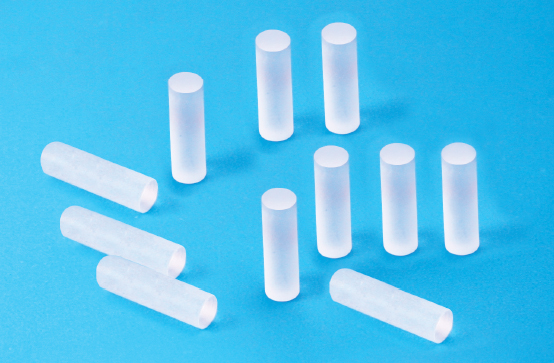
TGG (Terbium Gallium Garnet) is a well-established magneto-optical crystal known for its high Verdet constant, excellent optical transmission, and low optical loss. Under an external magnetic field, TGG exhibits the Faraday effect, causing the polarization plane of transmitted light to rotate. Thanks to its stable performance and relatively mature manufacturing processes, TGG has become an important material for Faraday rotators and optical isolators operating in the visible and near-infrared wavelength ranges.
Its key characteristics include:
- High Verdet constant, providing strong magneto-optical rotation.
- Excellent optical homogeneity and transmission.
- Low optical absorption, helping reduce thermal effects.
- Mature material technology and established application experience.
1.2 TSAG Magneto-Optical Crystal
TSAG (Terbium Scandium Aluminum Garnet) is an advanced magneto-optical crystal developed through the introduction of scandium and aluminum into a garnet crystal structure. It demonstrates considerable potential in improving magneto-optical performance. Compared with conventional TGG, one of TSAG's key advantages is its higher Verdet constant. Under the same magnetic field and crystal length, TSAG can potentially achieve a greater Faraday rotation angle. This makes TSAG a promising material for high-performance, compact magneto-optical devices and high-power laser systems.
Its key characteristics include:
- Higher Verdet constant and strong magneto-optical rotation potential.
- Potential to reduce crystal length for a given rotation angle.
- An alternative material for advanced Faraday rotator designs.
- Promising applications in high-power lasers and advanced optical systems.
It is important to note that the actual performance of TSAG depends on crystal growth quality, optical absorption, thermal properties, and processing techniques. Its overall performance should not be evaluated based on the Verdet constant alone.
2. Key Performance Comparison Between TGG and TSAG
Although both TGG and TSAG belong to the garnet family of magneto-optical crystals, their material compositions and performance characteristics differ. In practical applications, several key parameters should be considered.
2.1 Verdet Constant
The Verdet constant is a fundamental parameter used to evaluate the Faraday rotation capability of a magneto-optical crystal. A higher Verdet constant produces a greater polarization rotation angle under the same magnetic field strength and crystal length. One notable advantage of TSAG is its generally higher Verdet constant compared with TGG. Research has reported that at a wavelength of 632.8 nm, TSAG has a Verdet constant of approximately 152 rad/(T·m), compared with approximately 134 rad/(T·m) for TGG, representing an improvement of around 13%. The actual values and differences vary with wavelength.
Application Value: A higher Verdet constant makes it possible to achieve the required rotation angle with a shorter crystal or potentially reduce magnetic field requirements, providing greater design flexibility for compact magneto-optical devices.
2.2 Optical Absorption
Optical absorption directly affects light transmission efficiency and heat accumulation inside the crystal. In high-power laser systems, even relatively small absorption losses can generate significant thermal effects as input power increases. These effects may influence beam quality and device stability. TGG features low optical absorption and has been widely adopted in high-performance magneto-optical devices. TSAG also demonstrates potential for low absorption. Some studies have reported an absorption coefficient below 3,000 ppm/cm at 1064 nm.
Application Value: Low optical absorption helps minimize energy loss and thermal buildup, improving the stability of Faraday rotators under high-power operating conditions.
2.3 Thermal Properties
For high-power laser applications, thermal properties are essential to the overall performance of magneto-optical crystals. During laser operation, heat is generated within the crystal. Insufficient heat dissipation may cause temperature gradients, thermally induced birefringence, and thermal depolarization, ultimately affecting optical isolation performance. TGG offers good thermal conductivity and thermal stability. TSAG has also demonstrated promising thermal properties in research, with thermal conductivity approaching that of TGG under certain testing conditions.
Application Value: Excellent thermal properties help control temperature increases and thermally induced optical effects, supporting the stability and reliability required by high-power laser systems.
2.4 Crystal Growth and Processing
Beyond optical and thermal performance, crystal growth and processing capabilities are equally important in determining whether a material can achieve reliable industrial production. TGG benefits from relatively mature crystal growth and processing technologies, with extensive experience in dimensional control, optical finishing, and product consistency. Although TSAG offers significant magneto-optical performance potential, its crystal growth and processing still present challenges, including crystal cracking, internal stress, and dimensional control. Improving crystal growth quality and processing stability remains essential for its broader commercial adoption.
Application Value: Stable crystal growth, precision optical processing, and rigorous quality control are fundamental to moving magneto-optical crystals from laboratory research to large-scale industrial production.
3. TGG vs. TSAG: Performance Comparison at a Glance
| Performance Parameter | TGG | TSAG |
| Verdet Constant | High | Generally higher |
| Optical Absorption | Low | Potential for low absorption |
| Thermal Properties | Excellent | Promising; depends on crystal quality |
| Crystal Growth | Relatively mature | More challenging |
| Application Maturity | Widely commercialized | Emerging and developing |
| Key Advantage | Mature, stable, and reliable | Higher magneto-optical rotation potential |
It is important to emphasize that material selection should not rely on a single performance parameter. Practical evaluation requires comprehensive consideration of operating wavelength, laser power, crystal dimensions, magnetic field strength, thermal management, and device design.
4. Key Applications of TGG and TSAG Crystals
4.1 High-Power Fiber Lasers
In high-power fiber laser systems, Faraday isolators prevent reflected light from returning to the laser source, protecting the laser and associated optical components. TGG and TSAG crystals serve as essential rotation materials in these devices, supporting optical isolation in high-power laser applications.
4.2 Solid-State Lasers
In solid-state lasers and amplifier systems, magneto-optical isolators reduce interference caused by reflected light, helping maintain stable laser oscillation and amplification.
4.3 Precision Optics and Scientific Instruments
In precision optical experiments, laser measurement systems, and scientific instruments, magneto-optical crystals are used for polarization control, optical isolation, and non-reciprocal optical systems.
4.4 High-Performance Optical Isolators
As laser systems increasingly demand compact designs, higher power handling, and lower optical loss, magneto-optical crystals with high Verdet constants, low absorption, and excellent thermal properties offer new possibilities for next-generation optical isolator designs.
5. From TGG to TSAG: Future Trends in Magneto-Optical Crystals
With the rapid development of high-power lasers, fiber lasers, and advanced optical systems, magneto-optical crystals are evolving toward higher performance, lower optical loss, and greater reliability.
Key development trends include:
- Enhanced Magneto-Optical Performance: Optimizing crystal composition and structure to increase the Verdet constant and improve Faraday rotation capabilities.
- Lower Optical Loss: Improving material purity and crystal growth processes to reduce absorption and scattering losses.
- Improved Thermal Management: Enhancing thermal conductivity and thermo-optical properties to meet high-power laser requirements.
- Reliable Mass Production: Advancing crystal growth, precision processing, and quality control to achieve consistent product quality and scalable manufacturing.
With its mature material system and established application base, TGG will continue to play an important role in magneto-optical devices. Meanwhile, TSAG offers new possibilities for high-performance magneto-optical applications through its higher rotation potential.
Rather than being direct substitutes, these two materials are expected to complement each other across different application requirements.
6. GLSUN: Advancing the Industrialization of TGG/TSAG Magneto-Optical Crystals
As an important part of its full-chain optoelectronics strategy, GLSUN continues to advance the industrialization of TGG/TSAG magneto-optical crystals, focusing on the coordinated development of foundational optoelectronic materials and core optical devices. Guided by its strategic framework of “Materials Platform + Chip Manufacturing + Device Integration,” GLSUN is committed to building industrialization capabilities spanning foundational materials to core optical devices, providing material and technical support for magneto-optical components and related optical applications. Driven by the growing demand for high-power lasers, fiber lasers, and advanced optical systems, GLSUN will continue to deepen its expertise in magneto-optical crystal technology, advancing the performance optimization and application development of TGG and TSAG crystals.