
Optical Switches in AI Data Centers: The Core Engine of the All-Optical Interconnection Era
2026-11-05
With the rapid development of generative AI, large language models (LLMs), and high-performance computing (HPC), AI data centers are experiencing unprecedented growth in computing demand. From GPU clusters consisting of thousands of processors to large-scale computing networks spanning multiple racks and facilities, data traffic continues to increase, placing growing pressure on existing network architectures. Traditional electrical switching networks offer advantages in maturity, flexibility, and ecosystem development. However, as bandwidth requirements continue to rise in large-scale AI clusters, the power consumption, equipment complexity, and network scalability challenges associated with electrical switching and optical-electrical conversion are becoming increasingly significant.
Meanwhile, AI workloads are characterized by intensive communication, concentrated traffic patterns, and dynamic bandwidth requirements. Data center networks must therefore deliver not only higher transmission bandwidth but also greater flexibility in optical path management. Against this backdrop, optical switching technology is emerging as an important solution for next-generation AI data center networks and a key building block of the all-optical interconnection era.
1. Why Do AI Data Centers Need Optical Switching?
The networking challenges facing AI data centers are no longer limited to the transmission speed of individual links. They increasingly involve overall connectivity efficiency, energy consumption, and network resource utilization.
Three major challenges stand out:
- Continuously Growing Bandwidth Requirements
Large-scale AI training requires frequent data exchanges between GPUs, including communication patterns such as All-Reduce and All-to-All. As GPU clusters expand, network traffic grows rapidly, creating increasingly demanding requirements for high-speed interconnection.
- Increasing Network Power Consumption and System Complexity
Traditional network architectures typically involve multiple stages, including electrical switching, optical modules, and optical transmission. As port speeds and network sizes increase, the power consumption, heat dissipation, and operational complexity of network equipment also rise.
- Dynamic Changes in Network Traffic
Different AI workloads have different bandwidth requirements. Fixed network connections cannot always adapt efficiently to changing traffic patterns, potentially resulting in congestion on certain links while other network resources remain underutilized.
These challenges create a growing need for technologies that can dynamically adjust optical connections and optimize network resource allocation according to application requirements. Optical switching is becoming an important technology to address these demands.
2. How Does Optical Switching Empower AI Data Centers?
Optical switching technology establishes connections between different input and output fiber ports by directly switching optical signals. Unlike traditional electrical switching, optical switching can route signals directly in the optical domain without requiring full optical-electrical-optical (O-E-O) conversion at every switching node.
Its key advantages include:
- Reducing Unnecessary Optical-Electrical Conversion Overhead
In traditional electrical switching architectures, optical signals are converted into electrical signals for processing and then converted back into optical signals for transmission. Optical switching performs switching directly in the optical domain, eliminating unnecessary O-E-O conversion at the switching stage. For network applications suitable for direct optical circuit connections, this approach can help reduce power consumption and system complexity.
- Enabling Dynamic Network Topology Reconfiguration
Through optical switching equipment, data centers can dynamically adjust optical connections according to AI training workloads, GPU cluster communication requirements, and network traffic conditions. For example, when a particular GPU cluster requires greater communication bandwidth, the network control system can reconfigure optical paths to establish more direct connections, improving network resource allocation flexibility.
- Improving Network Scalability
As AI clusters expand from hundreds of GPUs to thousands or even tens of thousands, the number of network connections and the complexity of network topologies continue to increase. Large-port-count optical switching architectures provide more flexible connectivity options, supporting optical interconnection and resource scheduling across clusters of different sizes.
3. 3D MEMS: An Important Technology for Optical Switching in AI Data Centers
Among various optical switching technologies, MEMS (Micro-Electro-Mechanical Systems) has become an important approach for large-scale optical switching, thanks to its potential for high integration, low insertion loss, and scalable port capacity. 3D MEMS optical switching technology uses precisely controlled micro-mirrors to establish optical connections between different input and output fibers.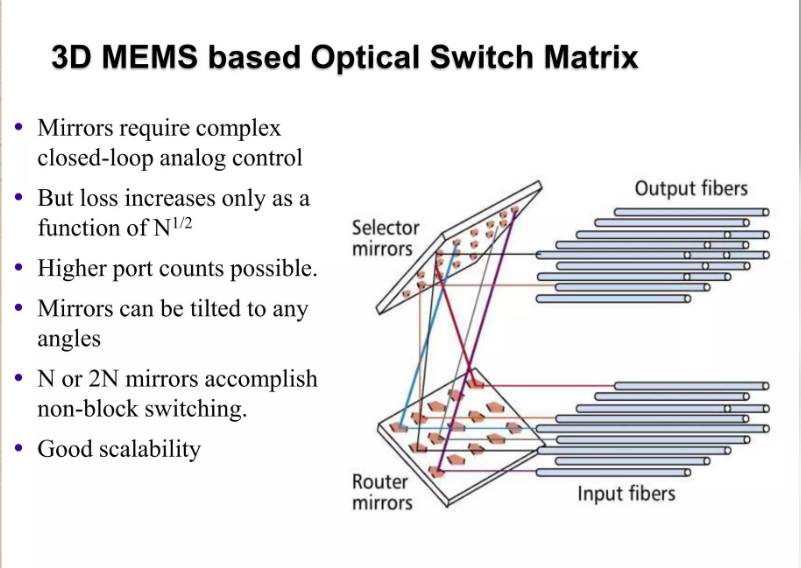
Its key technical characteristics include:
- Scalable Port Capacity: Supports matrix-based optical switching from small configurations to hundreds of ports.
- Low Insertion Loss: Optimized optical path design and precise alignment help minimize signal transmission loss.
- Protocol Transparency: Supports different transmission rates and protocols without processing the data content of optical signals.
- High Reliability: Precision MEMS structures, control algorithms, and long-term reliability testing support stable operation.
- Flexible Configuration: Supports software-based control and automated optical path management to accommodate dynamic network topologies.
Compared with traditional electrical switching equipment, MEMS OCS is particularly suitable for optical-layer connection reconfiguration. Rather than replacing all electrical switches, it complements existing electrical switching networks.
4. Typical Applications of OCS in AI Data Centers
Application 1: GPU Cluster Interconnection
In large-scale AI training clusters, GPUs need to exchange substantial amounts of data. OCS can dynamically adjust optical connections according to workload communication patterns, providing flexible interconnection paths between different GPU clusters or network segments.
Application 2: Data Center Network Topology Reconfiguration
Traditional network topologies are generally relatively fixed. OCS enables optical paths to be reconfigured through a control system, allowing data centers to adjust network connections according to changing business requirements and improve network adaptability.
Application 3: Data Center Interconnect (DCI)
In interconnection scenarios spanning multiple data centers or facilities, OCS can be used for optical fiber resource scheduling and link protection, providing flexible optical connectivity between different data center locations.
Application 4: Optical Network Protection and Redundancy
In network environments requiring link protection, optical switching equipment can switch to backup optical paths according to predefined strategies, supporting network recovery and service continuity.
It is important to note that the actual deployment benefits of OCS depend on network topology, control systems, traffic patterns, and optical link budgets. Not every network application is necessarily suitable for optical switching.
5. What New Requirements Does AI Data Center Development Place on OCS?
As AI infrastructure continues to expand, OCS technology faces increasingly demanding requirements.
| Technical Area | AI Data Center Requirements |
| Port Capacity | Support larger M×N optical switching matrices |
| Insertion Loss | Minimize optical link loss and optimize power budgets |
| Switching Speed | Meet optical path reconfiguration requirements across different applications |
| Reliability | Ensure stable, continuous, long-term operation |
| Compatibility | Support 400G, 800G, and higher-speed optical transmission systems |
| Intelligent Control | Support SDN, APIs, and automated network management |
| System Integration | Adapt to data center rack, equipment, and fiber management architectures |
Of particular importance, as 800G and 1.6T optical modules continue to develop, data centers are placing higher demands on optical link loss, path stability, and system integration. In the future, OCS will need to deliver not only large-scale port switching but also deeper integration with network control platforms, becoming an essential component of intelligent optical networks.
6. GLSUN: Advancing Large-Scale Optical Switching Through 3D MEMS Technology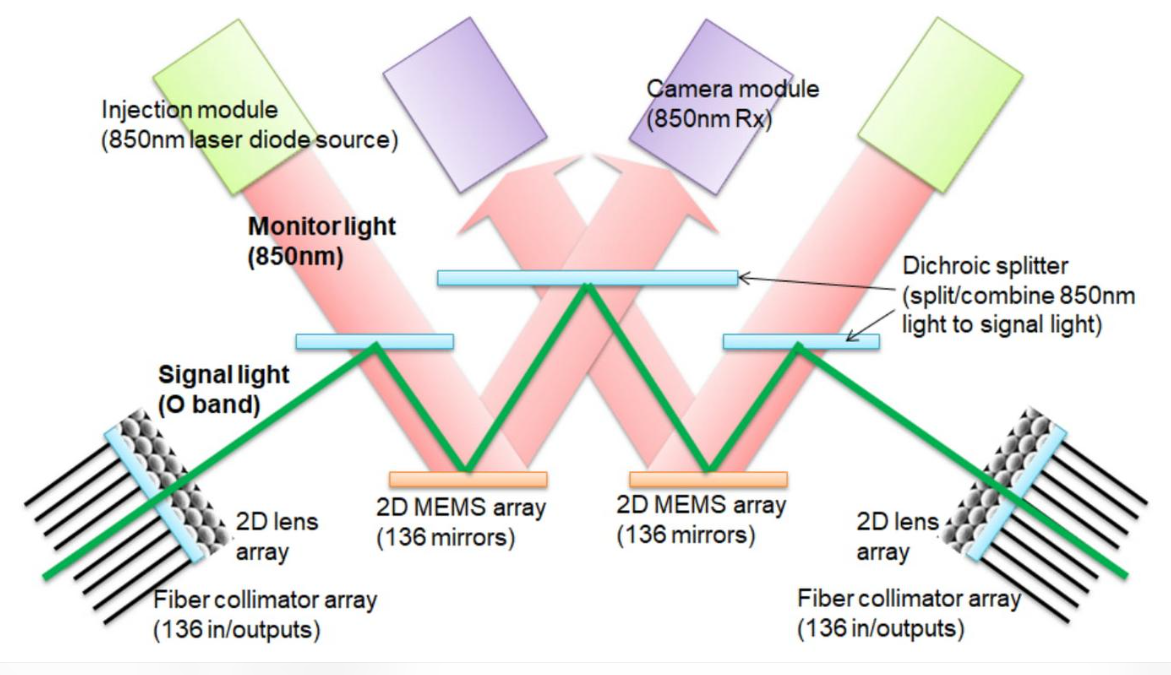
As a company deeply engaged in the optoelectronics industry, GLSUN has established a comprehensive industrial presence spanning optical chips, optical components, optical modules, and optical communication equipment. Through coordinated development across its business units, GLSUN continues to advance its full-chain optoelectronic capabilities and provide solutions for next-generation optical communication networks. In the field of optical switching, GLSUN focuses on 3D MEMS optical switching technology and large-scale matrix optical switching products, providing optical connectivity solutions for AI data centers, optical communication networks, and next-generation interconnection architectures.
Key advantages of GLSUN 3D MEMS OCS include:
1. Large-Scale Matrix Optical Switching
GLSUN offers multiple port configurations, including 32×32, 64×64, 128×128, 192×192, and 320×320, addressing optical connectivity requirements across different network scales.
2. Direct Switching in the Optical Domain
Based on 3D MEMS micro-mirror technology, GLSUN OCS establishes optical connections directly in the optical domain without requiring O-E-O conversion at the switching node, helping reduce conversion overhead within network architectures.
3. High-Speed and Multi-Protocol Transparent Transmission
GLSUN OCS supports optical transmission applications at different speeds, including 400G and 800G. Its protocol-transparent design enables flexible optical connectivity between different network devices without depending on a specific data protocol.
4. Flexible Software-Based Control
Supporting GUI-based operation as well as Telnet/SSH management interfaces, GLSUN OCS enables convenient optical path configuration, equipment management, and system integration. It can also work with upper-layer network control platforms to support automated network management.
5. Reliability Designed for Long-Term Operation
Through precision optical engineering, MEMS control technology, and reliability validation, GLSUN aims to improve equipment stability in complex network environments. The product design lifetime can reach more than 10⁹ switching cycles.
From core optical switching technology to complete equipment solutions, GLSUN is committed to providing flexible, reliable, and scalable optical switching infrastructure for next-generation data center networks.
7. From Optical Switching to All-Optical Interconnection: Future Development Trend
As AI computing infrastructure continues to evolve, optical switching technology is expected to develop in several important directions.
Trend 1: From Fixed Topologies to Dynamic Optical Networks
Future data center networks will increasingly focus on dynamically adjusting connectivity according to application requirements, enabling more flexible network resource allocation.
Trend 2: From Individual Devices to System-Level Collaboration
OCS will become more deeply integrated with optical modules, optical transmission equipment, network controllers, and SDN platforms, evolving from standalone devices into system-level optical networking solutions.
Trend 3: From Large Port Counts to Intelligent Network Management
As the number of optical ports increases, network management becomes more complex. Automated configuration, intelligent scheduling, real-time monitoring, and fault management will become increasingly important capabilities of OCS systems.
Trend 4: From Optical Interconnection to Hybrid Optical-Electrical Architectures
Future data centers are unlikely to completely replace electrical switching with optical switching. Instead, optical and electrical switching will work together, leveraging their respective strengths to build more efficient hybrid network architectures.
With the development of CPO, silicon photonics, and high-speed optical modules, optical interconnection will play an increasingly important role in AI data centers. OCS is also expected to become one of the key connectivity technologies supporting these next-generation architectures.
Conclusion: Unlocking AI Computing Potential Through Optical Connectivity
Behind the competition in AI computing power lies not only a competition in GPU performance but also one in data transmission efficiency and network architecture. As data centers move from traditional fixed connectivity toward more flexible and intelligent optical interconnection architectures, optical switching technology will introduce new possibilities for network connectivity and resource scheduling. GLSUN will continue to advance 3D MEMS optical switching technology, leveraging large-scale optical switching products and comprehensive optoelectronic capabilities to help AI data centers build more flexible, efficient, and reliable next-generation optical interconnection networks.