Five Key Application Scenarios for Reconstructing AI-Era Data Center Networks
2026-08-06
With the explosive growth of large AI models, GPU clusters, high-performance computing (HPC), and cloud computing, east-west traffic inside data centers is surging at an unprecedented rate. A single ultra-large-scale AI training cluster may contain tens of thousands or even hundreds of thousands of GPUs, which require frequent high-bandwidth, low-latency data synchronization and gradient exchange. Traditional Spine-Leaf architectures based on electronic Ethernet switches are facing increasingly severe challenges in bandwidth utilization, end-to-end latency, power consumption, and scalability.
Optical Circuit Switching (OCS), with its core advantages of low latency, low power consumption, no optical-electrical-optical (O-E-O) conversion, transparent transmission, and dynamic reconfigurability, is evolving from a traditional optical communication device into a critical piece of infrastructure for next-generation AI data center networks. By introducing OCS, data centers can deeply optimize network architecture, enable on-demand resource scheduling, and support flexible interconnection of ultra-large-scale GPU clusters—providing a solid network foundation for the explosion of AI computing power.
This article systematically introduces the five core applications of OCS in modern data centers.
Why Do Data Centers Need OCS?
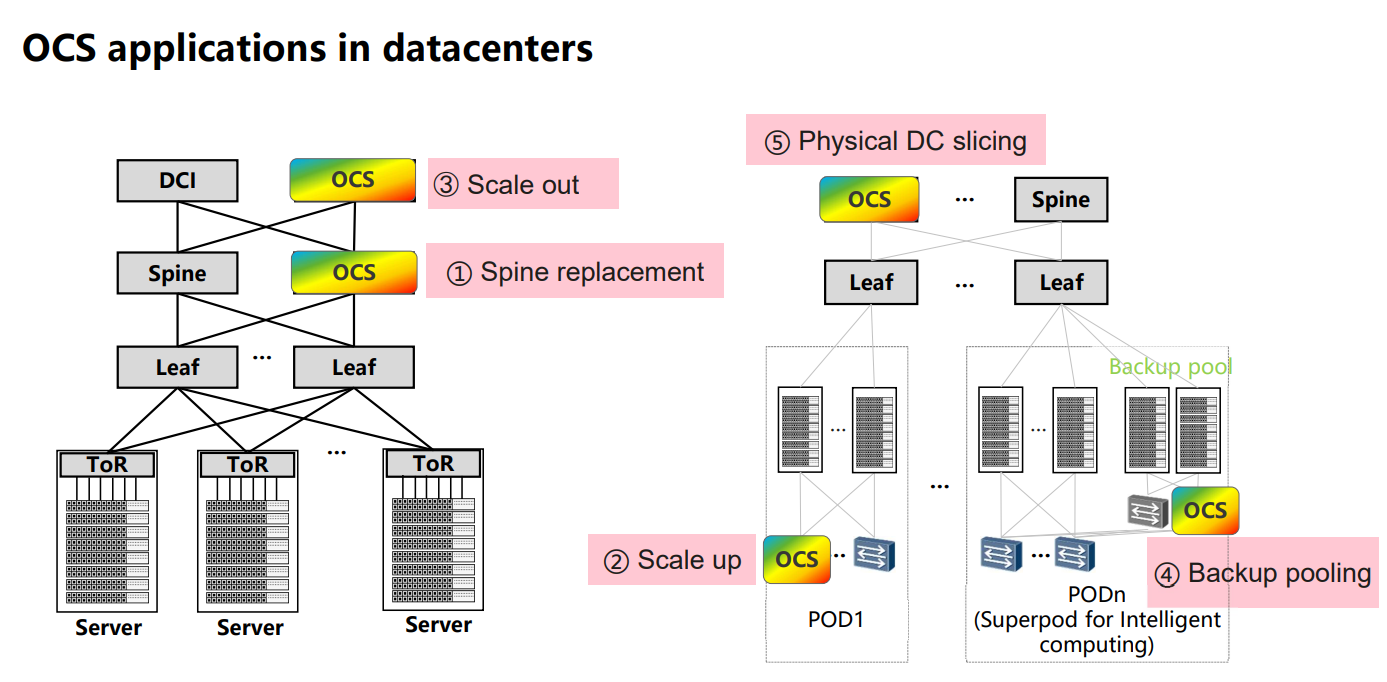
Traditional data centers typically adopt the classic Clos architecture (Spine-Leaf):
· Servers connect through Top-of-Rack (ToR) switches;
· ToR switches aggregate to the Leaf layer;
· Leaf switches interconnect with the Spine layer;
· Data centers interconnect via Data Center Interconnect (DCI).
As the number of GPUs scales from thousands to tens of thousands or even hundreds of thousands, large volumes of traffic must frequently cross racks, Pods, and even data centers. Traditional electrical switching networks increasingly reveal the following pain points:
· Network hierarchy continues to deepen, increasing hop count and cumulative latency;
· High-end switching chips keep rising in cost, creating significant investment pressure;
· Power consumption grows rapidly, making cooling and energy costs operational bottlenecks;
· Bandwidth utilization declines, and GPUs spend more time idle waiting for data;
· Fixed cabling and static configurations struggle to adapt to dynamically changing workloads.
The core value of OCS lies in its ability to dynamically establish optical paths so that network resources can be reconfigured in real time according to business needs, thereby significantly improving overall network efficiency and resource utilization.
Application 1: Spine Replacement
Keywords: Reduce switching layers, lower latency, cut cost and power
In traditional Clos networks, the Spine layer is responsible for all inter-Leaf data exchange. As network scale grows, the number of Spine switches increases sharply, high-end switching chips become expensive, and both latency and power consumption rise accordingly.
Deploying OCS at the Spine layer enables dynamic establishment of direct optical connections between Leaf switches, partially or fully replacing traditional Spine forwarding functions. Key advantages include:
· Fewer electrical switching hops and a simplified network hierarchy;
· Significantly reduced investment in high-end switching chips;
· Lower end-to-end network latency;
· Substantially reduced overall power consumption.
For the large number of relatively fixed or periodic communication flows in AI clusters (such as All-Reduce and parameter synchronization), OCS can establish stable optical paths that deliver near-direct-connect performance, greatly improving network efficiency and effective GPU utilization.
Application 2: Scale Up (Vertical Cluster Expansion)
Keywords: Build ultra-large GPU clusters, dynamic resource composition
Training large AI models typically requires massive numbers of GPUs working in coordination. The number of GPUs inside a single Pod is limited; when greater computing power is needed, multiple Pods must be flexibly interconnected to form a unified ultra-large training cluster.
In the Scale-Up scenario:
· Each Pod is equipped with its own OCS;
· Multiple Pods can be dynamically interconnected according to training requirements;
· GPU resources are unified and pooled for scheduling.
This approach achieves true vertical expansion. Advantages include:
· Dynamic composition of GPU clusters of different scales;
· Flexible matching of computing power to different model training needs;
· Reduced waste from fixed network connections;
· Significantly improved overall GPU utilization.
For example, a Pod with 512 GPUs can be temporarily combined with other Pods to form 1,024-, 2,048-, or even larger training clusters. Once the job completes, the resources can be quickly released for other workloads.
Application 3: Scale Out (Horizontal Network Expansion)
Keywords: Elastic capacity expansion, rapid network reconfiguration
As business grows, data centers continually need to add servers, racks, and switching equipment. Traditional expansion methods often require adding new Spine switches, adjusting large amounts of cabling, and modifying complex configurations—resulting in long cycles and high risk.
OCS can serve as a flexible platform for network expansion, enabling rapid Scale-Out:
· New racks can be quickly connected to the existing network;
· New Pods can join flexibly without impacting ongoing services;
· Large-scale re-cabling is unnecessary;
· Network capacity can be expanded on demand.
For large cloud data centers, this means the network can adapt more agilely to business growth, significantly shortening expansion cycles and reducing operational complexity and transformation costs.
Application 4: Backup Pooling (Shared Backup Resource Pool)
Keywords: Resource sharing, greatly improved utilization, lower TCO
Traditional data centers typically reserve dedicated backup servers or GPUs for each business unit. However, most of these backup resources remain idle for long periods, resulting in low GPU utilization, wasted capital investment, and high operational costs.
By using OCS to build a shared Backup Pool:
· Multiple Pods can jointly access the same set of backup GPUs or servers;
· When a Pod experiences GPU failure, server maintenance, or temporary shortage of computing power, OCS can rapidly establish optical connections to bring backup resources online for the current workload.
Core benefits include:
· Significant reduction in the total number of backup devices;
· Greatly improved utilization of expensive GPUs;
· Effective reduction of capital expenditure (CAPEX);
· Higher resource scheduling efficiency and business continuity.
For high-end AI GPUs valued at hundreds of thousands of dollars each (such as H100 or B200), shared backup resources can substantially lower the total cost of ownership (TCO) and become a key lever for improving data center economics.
Application 5: Physical DC Slicing
Keywords: Network isolation, on-demand networking, multi-workload coexistence
With the growth of multi-tenant cloud computing, a single large data center often needs to simultaneously support AI training, AI inference, HPC, enterprise cloud, storage, and other workloads. Different workloads have vastly different requirements for bandwidth, latency, isolation, and security.
OCS enables true physical network slicing (Physical DC Slicing):
· By dynamically configuring optical paths, a single physical network can be partitioned into multiple completely independent logical networks;
· Different workloads enjoy full isolation, dedicated bandwidth, and higher security;
· Slice size and topology can be adjusted at any time according to business needs.
For example, network resources can be concentrated on large-model training in the morning, quickly switched to HPC workloads in the afternoon, and then reconfigured for inference services at night. The entire process requires no re-cabling—only reconfiguration of the OCS—dramatically improving overall resource utilization and business responsiveness.
OCS Is Becoming the New Network Infrastructure for AI Data Centers
From the five applications above, it is clear that OCS is no longer merely an optical switching device in traditional optical networks; it is evolving into core network infrastructure for AI data centers. Its key value can be summarized as follows:
· Lower network latency: Fewer electrical switching nodes enable more efficient data transmission;
· Reduced energy consumption: Avoidance of frequent O-E-O conversions significantly cuts switching equipment power;
· Greater network flexibility: Dynamic optical path reconfiguration allows rapid response to changing business needs;
· Higher resource utilization: On-demand scheduling and sharing of GPUs, servers, and network resources;
· Support for ultra-large-scale AI clusters: Meets the interconnection requirements of future 10,000-card, 100,000-card, and even larger GPU clusters.
As 800G and 1.6T optical interconnects and co-packaged optics (CPO) technologies mature, OCS will deeply integrate with high-speed optical modules, silicon photonics, and intelligent network scheduling systems, becoming an important component of next-generation AI data center network architectures.
Conclusion
The rapid growth of AI computing power is accelerating the evolution of data center networks from traditional electrical switching toward optical switching. With its unique advantages of transparent transmission, ultra-low latency, extremely low power consumption, and flexible scheduling, OCS provides data centers with more efficient, economical, and sustainable network interconnection solutions.
From Spine replacement and Scale-Up/Scale-Out to shared backup pools and physical data center slicing, OCS is comprehensively enhancing data center scalability, resource utilization, and operational efficiency. Looking ahead, as ultra-large-scale AI clusters and intelligent computing networks continue to develop, OCS is poised to become a key technology for building next-generation intelligent data centers and optical interconnect networks—delivering a more efficient, flexible, and sustainable network infrastructure for the AI era.