
How WSS Works: The Technology Behind Flexible Optical Networks
2026-07-23
In the rapidly evolving world of optical communications, one device stands out as the cornerstone of modern flexible networking: the WSS (Wavelength Selective Switch). As data centers, 5G/6G networks, and AI infrastructure demand ever-greater bandwidth and agility, WSS technology has become essential for building dynamic, reconfigurable optical networks. This educational deep-dive explains what WSS is, how it actually works, the core technologies behind it (LCoS and MEMS), and why it is indispensable for ROADM systems. Whether you are a network engineer, student, or technology enthusiast, this article will give you a clear technical understanding of this critical optical component.
1. What Is WSS?
WSS, short for Wavelength Selective Switch, is an advanced optical device that can dynamically route, block, or attenuate individual wavelengths (channels) from a multi-wavelength input signal without converting the signal from optical to electrical domain (O-E-O).
Unlike traditional fixed optical filters or static multiplexers, a WSS offers software-controllable wavelength routing. It typically has one common input port and multiple output ports (e.g., 1×4, 1×9, 1×20, or even higher), allowing it to direct each wavelength to any desired output port independently.
Key capabilities include:
· Wavelength selection and routing
· Power equalization and attenuation
· Hitless (non-disruptive) switching
· Support for flexible grid (FlexGrid) spacing
WSS is the enabling technology that turns rigid point-to-point DWDM links into intelligent, mesh-capable optical networks.
2. How Does a WSS Work? High-Level Architecture
A WSS performs three fundamental operations in sequence:
· Wavelength Demultiplexing: Separates the incoming composite signal into individual wavelengths in the spatial domain.
· Wavelength Processing: Applies independent control (steering, attenuation) to each wavelength.
· Wavelength Multiplexing: Recombines the processed wavelengths onto the desired output ports.
This entire process happens entirely in the optical domain, delivering ultra-low latency and minimal power consumption compared to electrical switching.
3. Core Technologies: LCoS vs MEMS
Two dominant technologies power modern WSS devices:
LCoS (Liquid Crystal on Silicon)
· LCoS is currently the most widely adopted technology for high-performance WSS.
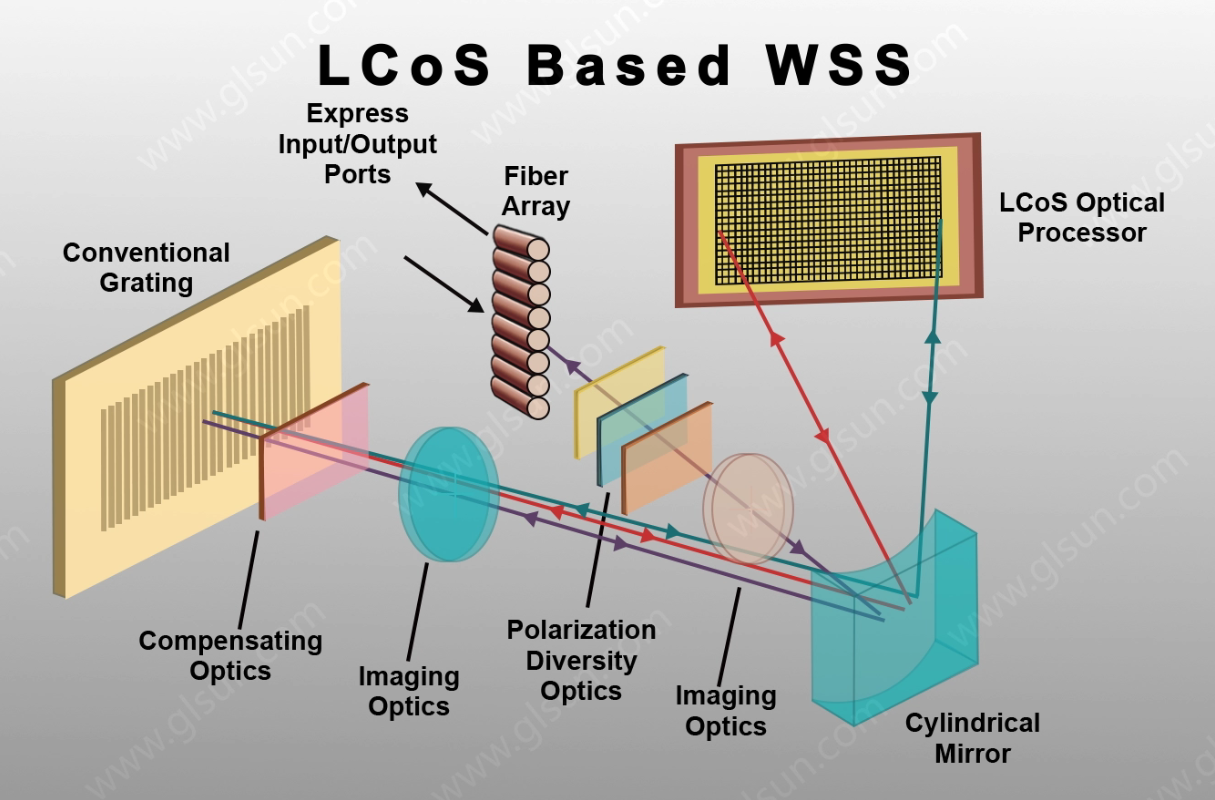
Working Principle: A polarized beam is dispersed by a diffraction grating onto an LCoS chip — a 2D array of liquid crystal pixels on a silicon backplane.
Each pixel can independently control the phase of reflected light. By creating programmable phase patterns, the device steers light to different output ports and controls attenuation.
Advantages:
· Excellent spectral resolution and flexibility (ideal for FlexGrid)
· Precise attenuation control (0.1 dB steps)
· No mechanical moving parts → high reliability
· Supports very high channel counts (96+ channels)
MEMS (Micro-Electro-Mechanical Systems)
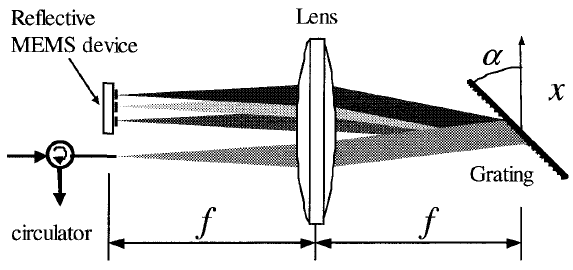
MEMS-based WSS uses tiny movable mirrors. Working Principle: After spatial separation by a grating, each wavelength hits a dedicated or shared MEMS mirror array. Tilting the mirrors redirects the light beam to the target output port.
Advantages:
· Fast switching speeds
· Mature technology with proven field reliability
· Good for moderate channel counts
Limitations compared to LCoS: Slightly lower spectral flexibility and higher insertion loss in some designs. Many leading manufacturers, including GLSUN, leverage LCoS for next-generation WSS products due to its superior flexibility in AI-era networks.
4. Wavelength Selection Mechanism
Wavelength selection in a WSS is achieved through spatial separation and selective steering:
· An incoming DWDM signal (containing dozens of wavelengths) enters the WSS.
· A diffraction grating or Arrayed Waveguide Grating (AWG) disperses the light angularly — each wavelength takes a slightly different path.
· The dispersed light lands on the switching engine (LCoS or MEMS).
· The control system maps each wavelength’s position and applies the appropriate phase/mirror command to direct it to the correct output fiber.
This process allows per-wavelength granularity — one wavelength can go to Port 1, another to Port 3, while a third is blocked or attenuated.
5. Optical Path Switching and Power Control
Beyond simple routing, modern WSS devices excel at:
· Hitless Switching: Re-routing wavelengths without interrupting traffic on other channels.
· Power Equalization: Automatically adjusting the optical power of each channel to compensate for different losses or amplifier tilt. This prevents stronger channels from · overwhelming weaker ones.
· Blocking: Completely attenuating unwanted wavelengths with high isolation (>40 dB typical).
· Broadcast/Multicast: Some advanced WSS support splitting a wavelength to multiple outputs.
These features make WSS ideal for dynamic traffic engineering in software-defined optical networks (SDON).
6. Why ROADM Must Use WSS
ROADM (Reconfigurable Optical Add/Drop Multiplexer) is the foundation of modern flexible optical networks. Without WSS, a ROADM cannot achieve true reconfigurability. Traditional FOADM (Fixed OADM) requires manual intervention or physical replacement of filter modules to change wavelength routing.
WSS-based ROADM enables Colorless, Directionless, Contentionless (CDC) functionality:
· Colorless: Any wavelength on any add/drop port.
· Directionless: Add/drop to any direction.
· Contentionless: Multiple instances of the same wavelength can be added/dropped without conflict.
In large-scale networks, especially AI data center interconnects and long-haul backbone networks, WSS-powered ROADMs dramatically reduce operational expenditure (OpEx), speed up service provisioning, and improve network resilience through fast optical restoration.
7. GLSUN WSS Solutions: Reliable and Advanced
GLSUN has established itself as a strong player in the WSS market by offering high-performance, cost-effective solutions tailored for both telecom operators and data center customers.
Notable features of GLSUN WSS products include:
· Wide range of port configurations (1×4 to 1×32+)
· Support for C-band, L-band, and C+L band
· Low insertion loss and excellent channel isolation
· High switching speed and hitless operation
· Flexible grid support for 50 GHz, 37.5 GHz, 25 GHz, and finer spacings
· Robust software control interfaces (SNMP, NETCONF/YANG) for easy SDN integration
· Telcordia-qualified reliability for carrier-grade deployments
GLSUN’s solutions combine advanced LCoS technology with optimized optical design, making them suitable for next-generation applications such as 400G/800G/1.6T transmission, AI-driven optical networks, and flexible metro/edge deployments.
Conclusion: The Future Belongs to Flexible Optical Networks
As bandwidth demands continue to skyrocket and network architectures become more dynamic, the Wavelength Selective Switch (WSS) will remain at the heart of optical innovation. Its ability to provide software-defined control over individual wavelengths is transforming static optical pipes into intelligent, responsive networks. Understanding how WSS works — from fundamental principles of LCoS and MEMS to real-world ROADM applications — is crucial for anyone involved in designing, deploying, or optimizing modern optical infrastructure. With continued advancements from companies like GLSUN, WSS technology is set to play an even more pivotal role in the AI era and beyond, powering the flexible, scalable, and efficient optical networks of the future.