
Why Optical Isolators Are Essential for High-Speed Optical Modules in the AI Computing Era
2026-07-01
With the rapid development of artificial intelligence (AI) large models, generative AI, cloud computing, and high-performance computing, global data centers are undergoing an unprecedented wave of infrastructure upgrades. Training a large model often requires the collaborative operation of thousands or even tens of thousands of GPUs. The massive data exchange between these computing nodes relies heavily on high-speed, low-latency, and low-power optical interconnection networks. It is precisely for this reason that optical modules are rapidly evolving from 400G to 800G and further toward 1.6T and even higher speeds.
In this process, every component inside optical modules faces more stringent performance requirements. The optical isolator, once considered merely an “auxiliary device,” has now become one of the critical core components affecting the stability, reliability, and lifespan of high-speed optical modules. Especially in AI computing clusters, hyperscale data centers, and high-speed optical communication systems, lasers are extremely sensitive to feedback light. Any minor reflection can cause performance fluctuations, making the importance of optical isolators increasingly prominent.
AI Computing Growth Drives Continuous Demand for Optical Isolators
In recent years, the scale of AI training clusters has continued to expand, and the demand for optical interconnection bandwidth within individual data centers has risen rapidly. To meet the needs of massive parameter transmission, model parallel computing, and distributed training, GPUs, switches, accelerators, and storage nodes must be connected via higher-speed optical links. Traditional electrical interconnections are gradually unable to keep up in terms of bandwidth, distance, and power consumption, making optical interconnection a key supporting technology for AI infrastructure.
Against this backdrop, 800G optical modules have begun large-scale commercialization, while 1.6T optical modules are accelerating in research, development, and deployment. Higher speeds mean stricter requirements for signal integrity, noise control, and lower system tolerance margins. For optical modules, even the slightest optical reflection, temperature drift, or device instability can impact the bit error rate and transmission quality of the entire link.
High-speed optical modules typically use high-performance lasers such as DFB (Distributed Feedback), EML (Electro-absorption Modulated Laser), or VCSEL as light sources. Among them, DFB and EML lasers are particularly widely used in long-distance, high-speed transmission scenarios. Although these lasers offer excellent performance, they are highly sensitive to return light. Reflections from fiber end faces, connectors, coupling interfaces, coated surfaces, or other optical components, if returned to the laser cavity, can cause output power fluctuations, frequency jitter, mode instability, increased phase noise, and even accelerated aging and shortened lifespan of the laser.
For AI data centers, network stability directly affects training efficiency and computing power utilization. Any abnormality in a high-speed link can not only degrade communication quality at a single node but may also interrupt entire training tasks, resulting in enormous losses of time and computing resources. Therefore, effectively suppressing reflected light and protecting laser stability has become a critical issue in high-speed optical module design, and the optical isolator is the key device to solve this problem.
Why Are Optical Isolators So Important?
The reason optical isolators occupy an important position in high-speed optical modules lies in their non-reciprocal transmission characteristics. Simply put, an optical isolator allows optical signals to pass smoothly in one direction while effectively blocking light from traveling in the opposite direction, forming a unidirectional “optical protection barrier.” This characteristic is particularly crucial for lasers. A laser is inherently a light source system highly sensitive to external feedback. Even a tiny amount of reflected light returning can alter its internal operating state. For high-speed modulated lasers, this effect is further amplified, ultimately manifesting as output instability, increased noise, and degraded modulation performance.
Optical isolators primarily perform the following functions:
· Suppress return light from entering the laser to avoid feedback interference;
· Stabilize laser output power and wavelength to improve light source consistency;
· Reduce system noise and improve signal-to-noise ratio and link quality;
· Prevent laser mode hopping, mode-locking failure, or self-oscillation;
· Enhance the long-term reliability and operational lifespan of the entire optical communication system;
· Strengthen the anti-interference capability of high-speed optical modules in complex environments.
As optical module speeds continue to increase, systems impose stricter requirements on optical power budgets, insertion loss, and reflection tolerance. Any minor optical feedback can affect overall performance. Therefore, optical isolators with high isolation, low insertion loss, and low polarization-dependent loss have become indispensable components in high-speed optical modules.
Working Principle of Optical Isolators
The core working mechanism of optical isolators stems from the Faraday Rotation Effect. This is a special physical phenomenon in magneto-optical materials: when linearly polarized light propagates along the direction of a magnetic field, its polarization plane rotates, and this rotation is non-reciprocal—meaning the polarization plane always rotates in the same direction regardless of whether the light travels forward or backward, unlike ordinary optical elements.
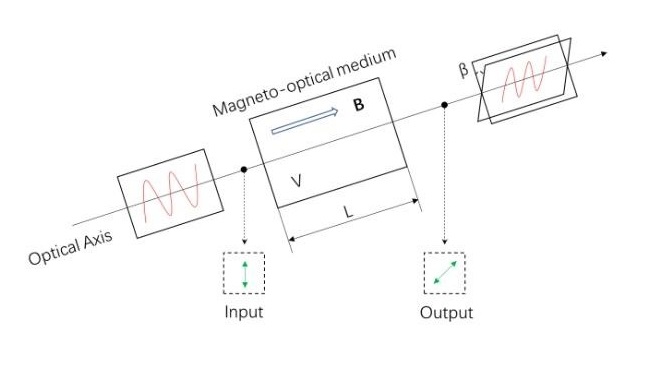
By leveraging this property, optical isolators combine polarizers, Faraday rotators, and magneto-optical crystals to achieve unidirectional transmission of optical signals. The basic process can be summarized as follows:
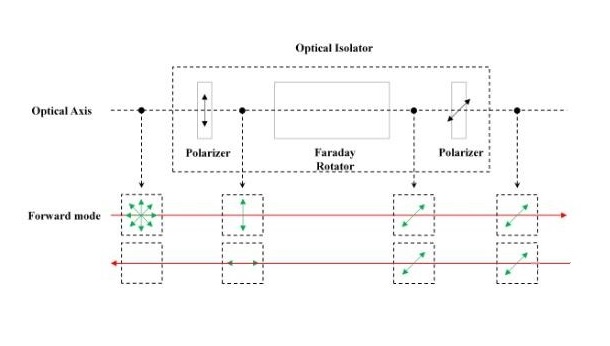
· Forward light, after passing through the polarizer and Faraday rotator, has its polarization direction rotated to align with the output polarizer and thus passes through smoothly;
· Backward (return) light undergoes the same Faraday rotation, but because the rotation direction remains unchanged, its final polarization becomes orthogonal to the input polarizer and is therefore blocked from re-entering the laser;
This creates a true “optical one-way valve” that effectively blocks return light.
From a system perspective, an optical isolator does not simply “block light.” It ensures high forward transmission efficiency while maximizing reverse suppression. This is why high-performance optical isolators must balance isolation, insertion loss, transmittance, and power handling capability.
Two Main Types of Optical Isolators
1. Free Space Optical Isolators
Free space optical isolators feature a classic structure, typically consisting of an input polarizer, a Faraday rotator, and an output polarizer. The light beam propagates in free space within the device, independent of direct fiber transmission, giving it good flexibility and performance in certain high-precision optical systems.
When light travels in the forward direction, the polarization rotates (typically by 45°) after the Faraday rotator to match the output polarizer’s transmission axis, allowing it to pass normally. When return light comes back, it experiences the same directional rotation, resulting in a total 90° rotation that makes it orthogonal to the input polarizer, preventing it from returning to the laser.
Free space isolators offer high isolation performance, mature structures, suitability for multiple wavelength ranges, and stable operation in high-power laser systems. To further improve isolation, some high-end applications use dual-stage isolation structures, allowing the beam to pass through two isolation processes for significantly enhanced suppression of reflected light. These are commonly used in laser systems, scientific equipment, and high-end industrial light sources that demand extreme stability.
2. Fiber Optic Isolators
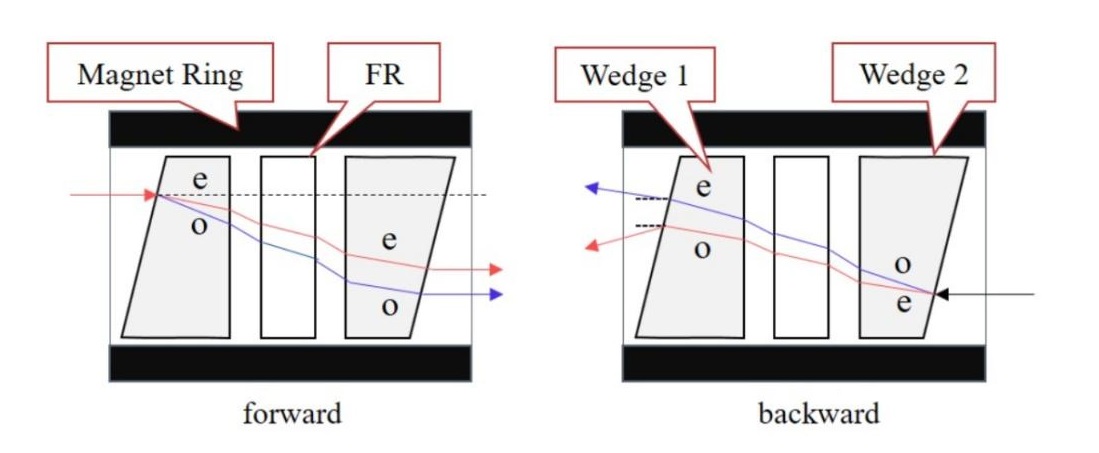
Fiber optic isolators are better suited to the needs of modern optical communication systems. They typically integrate collimators, Faraday rotators, birefringent crystals, polarizers, and fiber coupling structures, enabling direct integration into fiber links for more compact and easily deployable unidirectional transmission.
Compared to free space isolators, fiber optic isolators have the advantages of smaller size, easier integration, suitability for mass production, and convenient embedding into optical modules. They are therefore widely used in high-speed optical communications, EDFA optical amplifiers, fiber lasers, and some sensing systems. Especially in 800G and 1.6T optical modules, where miniaturization and high reliability requirements are increasing, the application value of fiber optic isolators continues to grow.
Additionally, with the development of silicon photonics, CPO (Co-Packaged Optics), and higher-density optical interconnection solutions, there is growing demand for smaller size, lower loss, and higher consistency in isolators. Miniaturized versions of fiber optic isolators will play an even more important role in next-generation optical communication architectures.
Key Performance Metrics for Evaluating Optical Isolators
When selecting optical isolators, it is not enough to consider only whether they can isolate light; a comprehensive evaluation of their performance in real systems is essential. The following parameters are typically the most important in engineering design and device selection:
· Operating Wavelength: The center wavelength for which the device is designed (common bands include 1310nm and 1550nm). Optimal transmittance and isolation are achieved only near the design wavelength.
· Insertion Loss: The power loss when the optical signal passes through the isolator. Lower insertion loss means less impact on forward light and higher system efficiency.
· Isolation: The key metric for measuring the device’s ability to suppress backward light (expressed in dB). Higher isolation provides stronger blocking of feedback light and is often the most critical parameter for high-speed lasers and AI data center modules.
· Transmittance: Reflects the transmission efficiency of forward light. Higher transmittance helps improve link budgets and overall performance.
· Average Power Handling: The continuous input power the device can handle stably over the long term. Critical for high-power lasers and amplifier systems.
· Polarization Dependent Loss (PDL): Lower PDL indicates less impact on different polarization states, improving system stability—especially important in high-speed modulation and precision measurement applications.
Typical Applications of Optical Isolators
Ultrafast Laser Systems
Femtosecond, picosecond, and mode-locked lasers are extremely sensitive to feedback light. Optical isolators effectively prevent return light from disturbing the laser cavity, thereby improving output stability, repeatability, and beam quality. They are standard components in ultrafast laser processing, precision micro-nano manufacturing, medical imaging, and scientific research.
Fiber Optic Amplifiers (EDFA)
In erbium-doped fiber amplifiers (EDFA) and similar systems, isolators prevent backward scattered or reflected light from entering the gain medium, avoiding self-oscillation, power fluctuations, and noise increase. They are vital for long-haul optical communication and high-power amplification applications.
Ultrafast Spectroscopy and Precision Measurement
In platforms such as TR-MOKE, pump-probe, white-light continuum, and time-resolved spectroscopy, optical isolators reduce background noise and improve measurement signal-to-noise ratio, providing more reliable experimental conditions.
High-Speed Optical Modules in AI Data Centers
In 800G and 1.6T deployments, optical isolators continuously suppress feedback light, enhance link stability, reduce bit error rates, and lower operational risks—delivering higher training efficiency and lower maintenance costs for AI computing networks.
Future Outlook
The continued advancement of AI, large model training, cloud computing, edge computing, and hyperscale data centers is driving ongoing upgrades in optical communication technology. Future optical modules will need to be faster, smaller, lower-power, more highly integrated, and more environmentally robust. In this trend, the importance of optical isolators will continue to grow. Future development directions may focus on higher isolation, lower insertion loss, greater miniaturization and integration, higher power handling, better thermal stability, and deeper integration with silicon photonics and CPO technologies.
High-performance optical isolators with superior isolation, low loss, compact size, and high reliability will be widely applied in high-speed optical modules, silicon photonic chips, CPO, fiber lasers, quantum communications, precision measurement, and advanced optical testing. For optical module manufacturers and system integrators, optical isolators are not only vital for protecting lasers but also a foundational element ensuring the long-term stable operation of entire optical links.
As AI computing power continues to grow, demand for high-speed optical interconnections in data centers will keep expanding. It is foreseeable that optical isolators will play an increasingly important role in next-generation high-speed optical communication systems, becoming a key force in driving performance upgrades and enhanced system reliability.