
Implementing Satellite Backhaul Backup for Base Stations
2026-01-29
In today’s communications infrastructure, terrestrial fiber is the dominant medium for base station backhaul, carrying core services that demand high bandwidth and ultra-low latency. However, in regions with complex geography or during extreme natural disasters—such as earthquakes or floods that damage fiber routes—the vulnerability of relying on a single physical fiber path is fully exposed. This can easily disconnect base stations from the core network, creating so-called ”communication islands”.
From a solution architect’s perspective, multi-dimensional redundancy must be built at both the physical and link layers. Thanks to its wide coverage and independence from terrestrial geographic constraints, satellite communication has become the optimal “last line of defense” for base station backhaul. Introducing satellite backhaul as a backup is not only a necessary measure to mitigate the risk of sudden fiber cuts, but also a key technical foundation for ensuring that critical nodes remain continuously connected.
The Architecture of Resilience: How Satellite Backhaul Works?
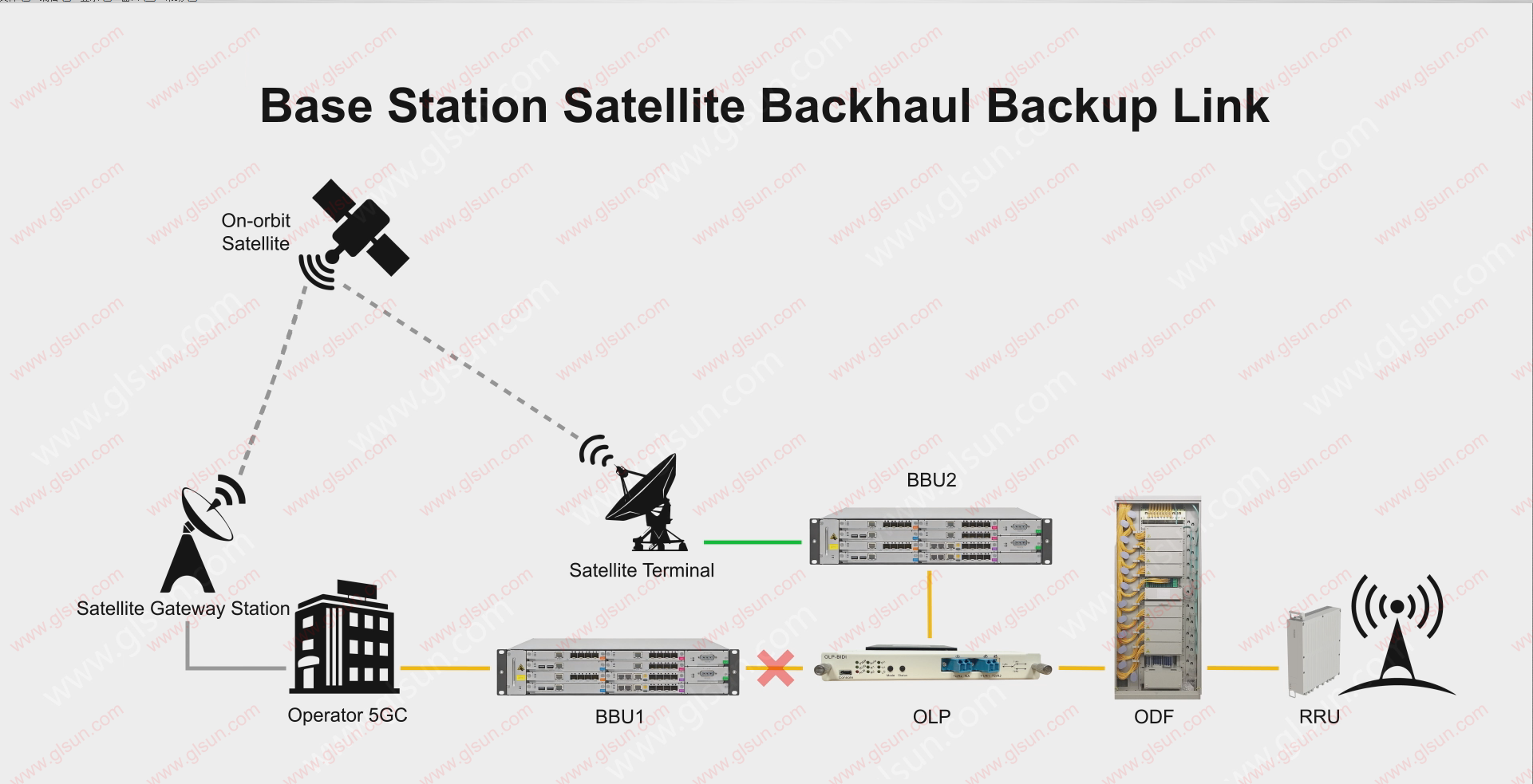
The solution employs a dual-link, geographically redundant architecture that integrates traditional terrestrial fiber with an orbital backup path. The system utilizes a specialized Optical Line Protection (OLP) device to manage the convergence of these heterogeneous links. As illustrated in the technical schematic, the backup path is established by introducing a redundant Baseband Unit (BBU2) that interfaces directly with satellite hardware, ensuring that the backhaul remains operational even if the primary fiber feeder is severed.
|
Link Type |
Path Components |
Transmission Medium |
|
Primary |
Operator 5GC → BBU1 → OLP → ODF → RRU |
Fiber (G.652/G.657) |
|
Backup |
BBU2 → Satellite Terminal → Satellite → Satellite Gateway |
Ethernet (Network Cable) / Satellite RF / Fiber |
Step-by-Step Technical Working Principle
Integrating satellite backhaul requires a coordinated failover automation process involving both the baseband and the optical switching layers. The workflow is categorized into three distinct operational phases:
Primary State (Normal Operations): Traffic flows through the standard terrestrial route: Operator Core → BBU1 → OLP → ODF → RRU. In this state, the OLP monitors the optical power levels of the fiber link coming from BBU1.
Backup Integration: A secondary, redundant Baseband Unit (BBU2) is provisioned at the site. This unit is connected via Ethernet (Network Cable) to a local Satellite Terminal (VSAT). The terminal maintains a link with an orbiting satellite, which in turn communicates with a terrestrial Satellite Gateway station, establishing a standby backhaul path that bypasses all terrestrial fiber infrastructure.
Fault Response (Failover): When a failure is detected—specifically a break in the primary fiber link between BBU1 and the OLP (indicated by the "X" in the architecture)—the OLP device detects the loss of the optical signal. It instantly triggers a switch of the optical path from BBU1 to BBU2, rerouting the site’s traffic through the satellite segment to the core network.
The Core Enabler: OLP (Optical Line Protection) Device
The OLP device is the strategic "decision-maker" within this hybrid architecture, functioning as the convergence point for terrestrial and non-terrestrial backhaul. Its technical highlights include:
Millisecond-Level Automatic Switching: Through continuous optical power monitoring, the OLP can execute a failover in under 50ms. This rapid automation is critical for maintaining link-layer stability and preventing the network management system from marking the site as "down."
Multi-Link Compatibility: The OLP is engineered to bridge heterogeneous hardware, facilitating simultaneous interfacing between the legacy BBU1, the satellite-specific BBU2, and the Remote Radio Unit (RRU). It provides the physical layer adaptability required for a "Fiber + Satellite" hybrid model.
Zero Service Perception: Because the switch occurs at the millisecond level, active user sessions—including Voice over LTE (VoLTE) calls and high-speed data transfers—do not drop. This ensures a seamless end-user experience despite a catastrophic failure of the primary backhaul feeder.
Scenario-Specific Reliability: Unlike generic optical switches, this OLP is purpose-built for base station architectures. It is designed to withstand the operational demands of remote site environments, providing a hardened layer of reliability specifically targeted at physical-layer fiber interruptions.
Conclusion: Redefining Base Station Reliability
The implementation of a "Fiber + Satellite" hybrid backhaul architecture represents a paradigm shift in network resilience, moving away from a reliance on single-medium terrestrial paths toward true path diversity. By leveraging the OLP device for automated millisecond failover, operators can ensure that a physical fiber break does not result in a service outage. This solution effectively transforms the satellite segment into a high-availability insurance policy, safeguarding communication continuity and enhancing the overall robustness of the telecommunications infrastructure in any environment.