
Wavelength Selective Switches for ROADMs
2026-01-07
In the rapidly evolving world of optical communications, the demand for high-capacity, flexible, and efficient networks has never been greater. At the heart of modern reconfigurable optical networks lies the Wavelength Selective Switch (WSS), a critical component that powers Reconfigurable Optical Add-Drop Multiplexers (ROADMs). This article explores the fundamentals of WSS technology, its integration with ROADMs, key advantages, and future prospects.
What is a Wavelength Selective Switch (WSS)?
A Wavelength Selective Switch is an optical device that allows for the dynamic selection, routing, and switching of individual wavelengths (or channels) in a wavelength-division multiplexed (WDM) signal without converting the optical signal to the electrical domain. Essentially, it acts as a programmable filter and switch, enabling network operators to manipulate specific wavelengths independently within a fiber optic cable.
WSS technology typically employs advanced mechanisms such as Micro-Electro-Mechanical Systems (MEMS), Liquid Crystal on Silicon (LCoS), or beam steering optics to achieve this functionality. For instance, in an LCoS-based WSS, incoming light is dispersed by a grating, and each wavelength is directed to a specific pixel on the LCoS array, where it can be attenuated, switched, or passed through to a desired output port. This level of control is essential for handling the dense wavelength packing in modern DWDM (Dense WDM) systems, which can support hundreds of channels per fiber.
Understanding ROADMs
Before delving deeper into WSS, it's important to understand ROADMs. A Reconfigurable Optical Add-Drop Multiplexer is a device used in optical networks to add, drop, or pass through specific wavelengths at network nodes. Unlike traditional Optical Add-Drop Multiplexers (OADMs), which are fixed and require manual reconfiguration, ROADMs offer remote and software-controlled flexibility. This reconfigurability is crucial for adapting to changing traffic patterns in metro, long-haul, and data center interconnect networks.
ROADMs come in various architectures, such as Colorless, Directionless, and Contentionless (CDC), which enhance their versatility. The core enabler of these features is the WSS, which allows for wavelength-agnostic routing and minimizes wavelength contention.
The Role of WSS in ROADMs
In a typical ROADM setup, WSS modules are deployed at the input and output stages. When an optical signal enters the ROADM, it is first demultiplexed into individual wavelengths. The WSS then selectively routes these wavelengths: some may be dropped to local receivers, others added from local transmitters, and the rest passed through to the next node.
For example, in a broadcast-and-select ROADM architecture, the incoming signal is split and fed into multiple WSS units, each handling routing to different directions. This setup supports multi-degree ROADMs, which can connect to multiple fibers (e.g., 8-degree or higher), making them ideal for mesh networks. The WSS ensures non-blocking switching, meaning any wavelength can be routed to any port without interference.
To illustrate, here's a simplified diagram of a WSS in a ROADM context:
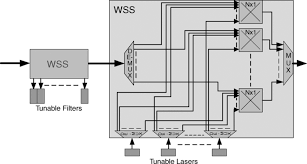
This diagram shows how the WSS architecture integrates into the ROADM, highlighting the wavelength routing paths.
Key Technologies and Implementations
WSS devices have evolved significantly. Early versions were based on fixed-grid spacing (e.g., 50 GHz or 100 GHz), but modern flexible-grid WSS support variable channel widths, enabling superchannels and higher spectral efficiency. Companies like InLC Technology and Finisar (now part of II-VI) offer advanced WSS solutions for core, metro, and edge applications.
Photonic integrated circuits are also being used to miniaturize WSS, combining switches across platforms like silicon photonics for lower power and cost. These innovations address challenges like insertion loss, crosstalk, and polarization dependence.
Another example of WSS implementation:
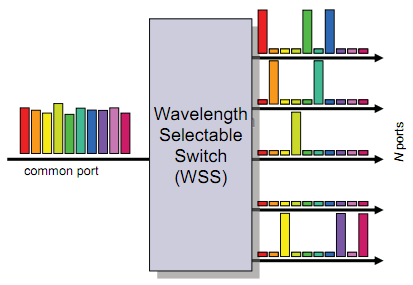
This image depicts the internal structure of a WSS, showing beam steering and wavelength dispersion.
Advantages of WSS-Enabled ROADMs
The integration of WSS in ROADMs brings numerous benefits:
Flexibility and Scalability: Networks can be reconfigured remotely, reducing operational expenses and enabling rapid service provisioning.
Efficiency: By avoiding O/E/O (optical-electrical-optical) conversions, WSS minimizes latency and power consumption.
Cost Savings: Dynamic wavelength allocation optimizes bandwidth usage, delaying the need for new fiber deployments.
Resilience: In case of failures, wavelengths can be rerouted quickly, enhancing network reliability.
These advantages are particularly valuable in 5G backhaul, cloud computing, and hyperscale data centers, where traffic is unpredictable and explosive.
Challenges and Future Trends
Despite their strengths, WSS and ROADMs face challenges like high initial costs and the need for precise calibration. Ongoing research focuses on increasing port counts (e.g., 1x32 or higher) and integrating AI for automated optimization.
Looking ahead, the shift to coherent optics and space-division multiplexing (SDM) will demand even more advanced WSS. Multi-core fiber support and quantum-safe encryption integration are on the horizon. By 2030, WSS-enabled ROADMs are expected to underpin terabit-per-second networks, driving the next generation of global connectivity.
Conclusion
Wavelength Selective Switches are the linchpin of modern ROADMs, transforming rigid optical networks into agile, intelligent infrastructures. As data demands soar, WSS technology will continue to evolve, ensuring seamless, high-speed communication worldwide. For network engineers and operators, understanding and deploying WSS is key to staying ahead in the optical revolution.