
Wavelength Selective Switching Enabling Intelligent Optical Bandwidth Management
2026-01-23
In an era of explosive data growth driven by cloud computing, 5G/6G networks, AI, and IoT, efficient optical bandwidth management has become essential. Optical fiber networks utilize Wavelength Division Multiplexing (WDM) to transmit multiple signals simultaneously over a single fiber using different wavelengths, dramatically increasing capacity. However, static wavelength allocation can no longer meet the dynamic demands of modern networks. Wavelength Selective Switching (WSS) emerges as a core enabling technology, allowing dynamic routing and bandwidth management at the individual wavelength level without optical-electrical-optical conversion.

Principles of Wavelength Selective Switching
WSS is a fundamental building block in Reconfigurable Optical Add-Drop Multiplexers (ROADMs) and Optical Cross-Connects (OXCs). It selectively routes individual wavelengths from an input fiber to desired output ports in the optical domain.
The typical operation flow includes:
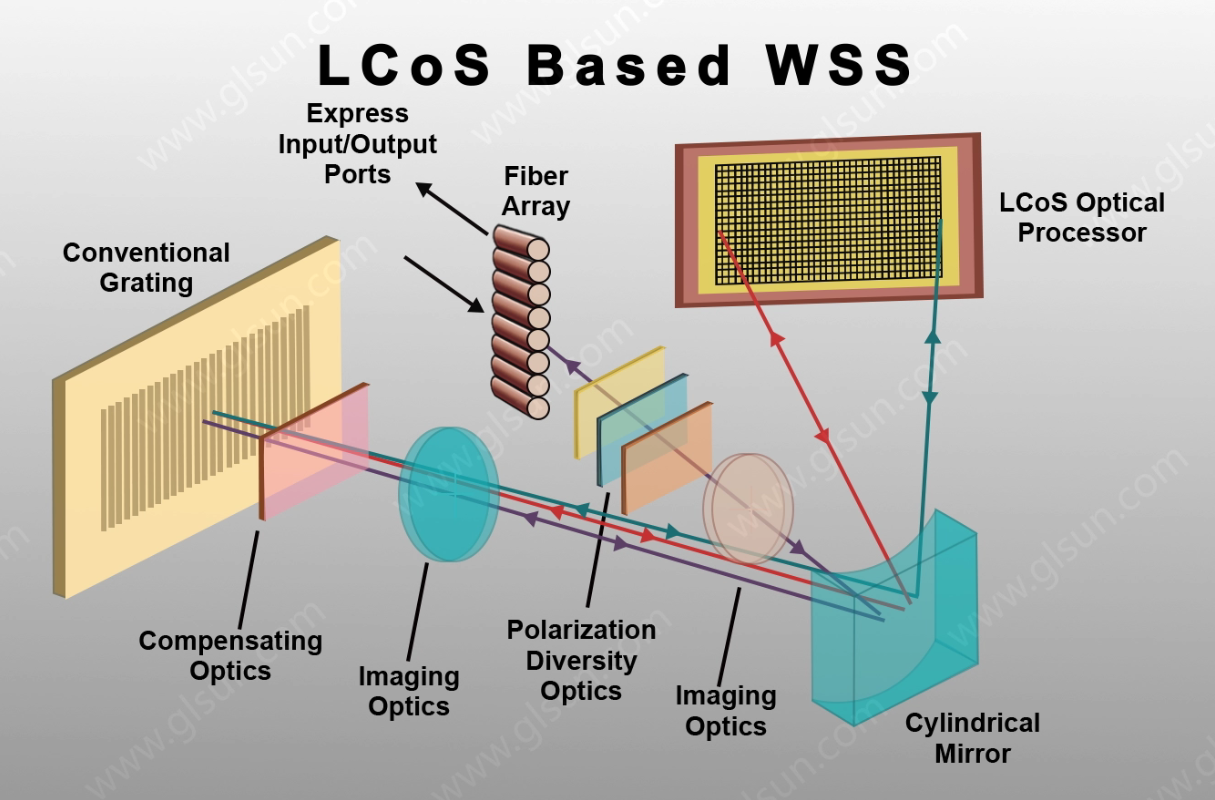
Demultiplexing: The incoming WDM signal is separated into individual wavelengths using diffraction gratings or Arrayed Waveguide Gratings (AWG).
Wavelength Selection and Switching: Each wavelength is directed to a switching element. Mainstream technologies include:
· LCoS (Liquid Crystal on Silicon): Phase modulation of light enables precise beam steering.
· MEMS (Micro-Electro-Mechanical Systems): Tiny mirrors mechanically redirect wavelengths.
Multiplexing and Output: Selected wavelengths are recombined and sent to the target output ports.
Modern WSS devices support the ITU-T Flexible Grid standard, with channel widths continuously adjustable from 12.5 GHz to hundreds of GHz, perfectly suited for coherent superchannel applications.
The Role of WSS in Optical Bandwidth Management
Optical bandwidth management focuses on how efficiently wavelength resources are allocated, adjusted, and protected across the network. WSS plays a central role in this process by enabling:
Dynamic Bandwidth Allocation: With WSS, operators can dynamically add, drop, or reroute wavelengths based on real-time traffic demands. Bandwidth can be provisioned or reallocated within minutes—rather than days—without manual fiber reconnections.
Fine-Grained Wavelength Control: Each wavelength can be independently switched, allowing precise bandwidth assignment to different services, customers, or applications. This is essential for:
· Multi-service transport networks
· Data center interconnection (DCI)
· Enterprise private networks
Support for Flex-Grid and Variable Bandwidth Channels: Modern WSS supports flexible channel spacing, enabling elastic optical networks where bandwidth scales from 50G to 400G and beyond. This adaptability significantly improves spectrum utilization efficiency.
Fast Network Reconfiguration and Restoration: In case of fiber failure or congestion, WSS enables rapid optical-layer protection and restoration by rerouting wavelengths automatically—minimizing service disruption and improving network resilience.
WSS as the Core Engine of ROADM Networks
Reconfigurable Optical Add-Drop Multiplexers (ROADMs) rely on WSS as their core switching element, enabling fully flexible optical layer management.
ROADM Capability Comparison
| Feature | Fixed OADM | ROADM with WSS |
|---|---|---|
| Wavelength add/drop | Predefined, manual | Dynamic, remote |
| Network flexibility | Low | High |
| Service provisioning time | Days / Weeks | Minutes |
| Optical-layer protection | Limited | Automatic |
| Suitability for dynamic traffic | Poor | Excellent |
Accelerating Data Center Interconnection (DCI)
In DCI scenarios, bandwidth demand grows fast and fluctuates frequently. Static wavelength planning leads to wasted capacity or bottlenecks.WSS enables elastic and scalable optical interconnection between data centers.
DCI Bandwidth Management Comparison
| Aspect | Traditional DCI | WSS-Enabled DCI |
|---|---|---|
| Bandwidth scalability | Limited | On-demand |
| Capacity utilization | Medium | High |
| Network expansion | Hardware-intensive | Software-driven |
| Service activation speed | Slow | Fast |
| Investment efficiency | Moderate | Optimized |
Enabling Flex-Grid for Elastic Optical Networks
Fixed-grid DWDM (50 GHz / 100 GHz) no longer matches the needs of modern high-speed transmission. Flex-Grid introduces variable channel spacing, and WSS is the key enabler.
Fixed-Grid vs. Flex-Grid (with WSS)
| Parameter | Fixed-Grid | Flex-Grid with WSS |
|---|---|---|
| Channel spacing | Fixed | Adjustable |
| Bandwidth granularity | Coarse | Fine |
| Spectrum efficiency | Limited | Optimized |
| Support for 400G/800G | Restricted | Native |
| Network future-proofing | Low | High |
Future Development Trends
· Looking forward, WSS technology is evolving in several directions:
· Silicon-photonics-integrated WSS for smaller size and lower cost
· AI/ML-driven intelligent wavelength allocation and predictive reconfiguration
· Support for Space Division Multiplexing in multi-core/multi-mode fibers
· Sub-millisecond switching speeds enabling Optical Burst Switching
· Compatibility with Quantum Key Distribution channels.
Conclusion
Wavelength Selective Switching (WSS) is the cornerstone technology for achieving efficient, flexible optical bandwidth management in modern networks. It transforms rigid, static optical infrastructures into programmable, on-demand intelligent systems. As data traffic continues its explosive growth and coherent systems scale to 400G/800G/1.6T and beyond, WSS will remain indispensable. For network operators and equipment vendors, mastering and investing in advanced WSS solutions is not only a response to current challenges but a strategic foundation for the next generation of digital optical networks.